
WORK INJURY & WORKERS' COMPENSATION CARE
Injured on the Job in
North County?
Immediate clinical evaluation, compliant initial documentation, and straight-forward rehabilitation protocols designed to return injured workers safely back to work.
Same-day work status reports ·

CRITICAL COMPLIANCE NOTICE
Report It First
Before scheduling your medical evaluation, state workers' compensation regulations require that you immediately notify your employer or supervisor in writing. Prompt official notification establishes your formal claim record and secures your legal eligibility for medical benefits.
- Submit formal written notice of injury to your direct supervisor within the required statutory window.
- Obtain the official claim number and workers' compensation insurance carrier contact information.
- Request written medical treatment authorization to ensure all diagnostic and clinical evaluations are fully covered.
CLINICAL SPECIALIZATION
Work Injuries
Dr. Shekhani Treats
Whether resulting from an acute traumatic incident on the job or gradual wear from repetitive motion, our clinical evaluations establish definitive causation, functional impairment, and targeted rehabilitation plans.
Lifting & Lumbar Strain
Acute muscle tears, ligament sprains, and mechanical lower back instability caused by heavy lifting, twisting, or load shifting in warehouse and industrial settings.
Repetitive Strain & Carpal Tunnel
Median nerve compression, tendonitis, and chronic micro-trauma from sustained keyboard use, assembly line tasks, or prolonged vibrational tool operation.
Shoulder & Rotator Cuff
Impingement syndrome, rotator cuff tears, and labral damage arising from overhead work, repetitive reaching, or sudden resistance against falling machinery.
Slip, Trip & Fall Injuries
Direct-impact trauma including coccyx fractures, contusions, ankle fractures, and joint derangement sustained during workplace premises accidents.
Nerve Damage & Radiculopathy
Radiating extremities pain, chronic numbness, peripheral neuropathy, and motor reflex degradation evaluated via comprehensive electrodiagnostic protocols.
Herniated & Bulging Discs
Cervical and lumbar disc protrusions causing severe spinal cord or nerve root impingement, documented with high-resolution MRI reviews and functional tests.
SPECIALIZED MEDICAL DOCUMENTATION
Evaluations and Reports for
Work Injury Matters
Defensible clinical documentation, objective impairment measurements, and evidence-based diagnostic clarity designed to resolve claim complexity and establish clear medical baselines.
Functional Capacity Evaluation (FCE)
Comprehensive, objective testing batteries measuring physical tolerance, lifting limits, postural endurance, and safe return-to-work parameters according to statutory guidelines.
Independent Medical Examination (IME)
Impartial, physician-conducted evaluations addressing causal relationship, maximum medical improvement (MMI), apportionment, and formal disability rating calculations.
Electrodiagnostic Study (EMG)
Precision nerve conduction velocity (NCV) and electromyography to identify radiculopathy, carpal tunnel syndrome, and neuropathic injury with electrophysiologic precision.
RETURN-TO-WORK PROTOCOL
Work Restrictions and
Getting Back to the Job
Vague work notes create friction, prolonged disability, and administrative disputes. Our clinical approach centers on defining explicit, defensible functional capacities based on verifiable medical evaluations.
By documenting exact physical thresholds—lifting limits, positional tolerances, and duty durations—we ensure injured workers heal safely while employers and adjusters receive the definitive clarity required for proper modified duty accommodation.
Concrete Functional Terms
Restrictions specify exact poundage limits, reach angles, and posture tolerances rather than ambiguous categories.
Objective Clinical Basis
Every limitation is substantiated by physical exam findings, verified diagnostic testing, and medical guidelines.
Progressive Updates
Physical capacities are systematically re-tested as healing progresses, modifying duty allowances toward full recovery.
Clear Multi-Party Reporting
Formal restriction forms are transmitted within 24 hours to patient, employer, and insurer to maintain aligned expectations.
PHYSICIAN CREDENTIALS & SPECIALTY
Why a Physical Medicine
and Rehabilitation Physician
Physiatry is the medical branch dedicated to diagnosing and treating nerve, muscle, and bone disorders that cause pain and functional impairment. Rather than focusing exclusively on surgical intervention, a PM&R physician specializes in objective physical capacity evaluations and definitive medical determinations tailored for complex workers' compensation claims.
30+ Years
Clinical Experience
15,000+
Evaluations Completed
Board Certified
Physical Medicine & Rehab
In-Office
Diagnostic EMG & Testing
CASE MANAGERS & EMPLOYERS
Referring an Injured Employee?
We provide priority intake, expedited clinical evaluations, and compliant work status reports within 24 to 48 hours. Direct communication with nurse case managers and claims adjusters ensures seamless case progression without administrative delays.
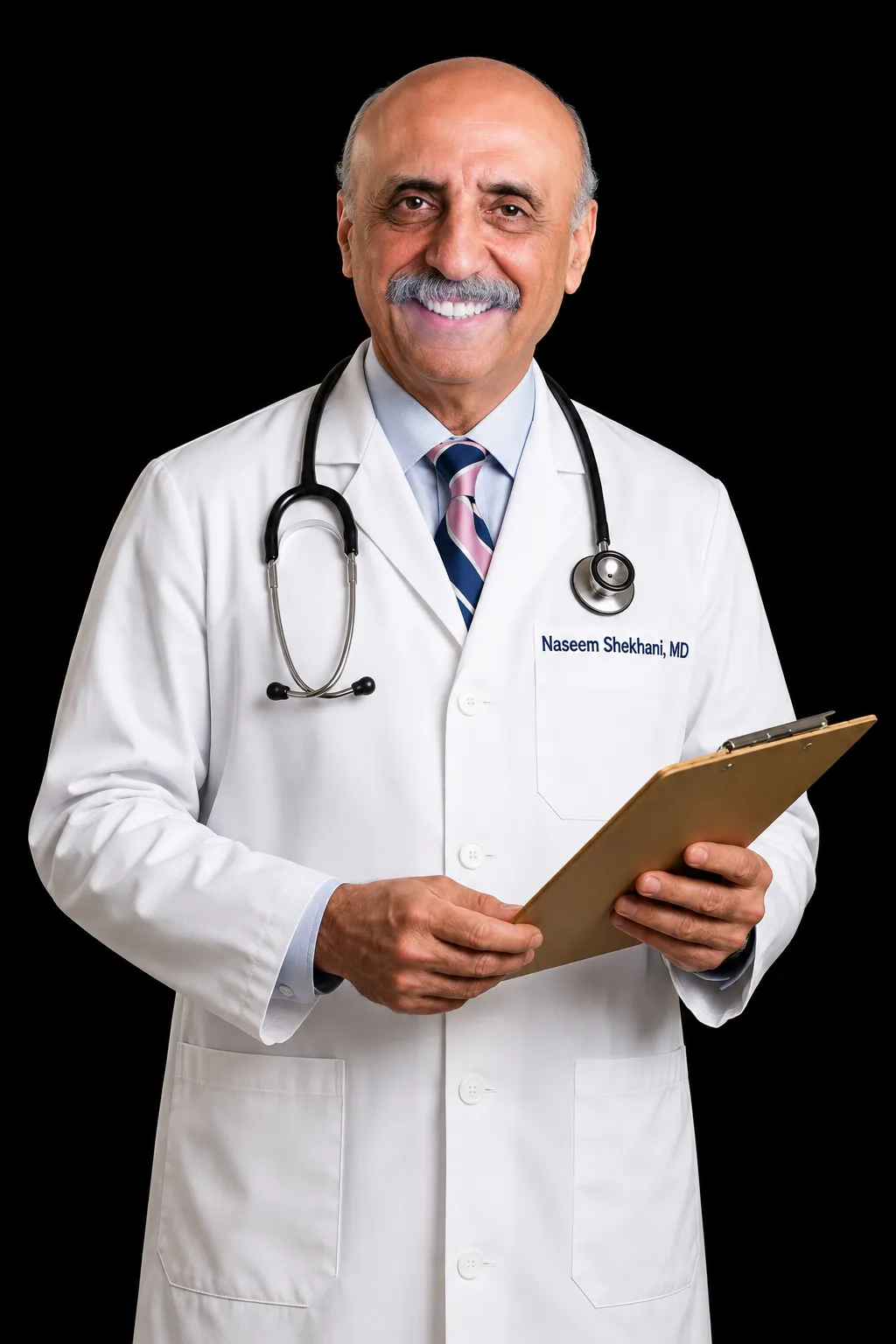
PHYSICIAN LEADERSHIP & CLINICAL BIO
Naseem Shekhani, MD
Board-Certified Physiatrist & Workers' Compensation Evaluator
Dr. Naseem Shekhani brings over thirty years of specialized clinical experience to injured workers and employers across the Greater St. Louis and Florissant communities. As a board-certified physician in Physical Medicine and Rehabilitation (PM&R) and a Fellow of the American Academy of Physical Medicine and Rehabilitation, Dr. Shekhani delivers authoritative diagnostic assessments, objective impairment evaluations, and evidence-based work restriction plans designed to facilitate safe, sustainable recovery.
- Board Certified: American Board of Physical Medicine and Rehabilitation
- Fellow: American Academy of Physical Medicine & Rehabilitation (FAAPMR)
- Over 30 Years of Direct Practice in Florissant & Greater St. Louis
- Specialized in Objective Work Comp Impairment Ratings & Medical Documentation
Missouri Work Injury: Questions Patients Ask
Evaluation, diagnostic testing, second opinions, and how a work injury claim intersects with your medical care.
Who chooses the doctor in a Missouri workers' compensation claim?
In Missouri, the employer and its workers' compensation insurer generally have the right to direct authorized medical care — which usually means treatment is arranged through a provider they select. How that applies to your specific claim depends on its posture, whether the claim has been accepted or denied, and other facts this office is not in a position to assess. That is a question for a Missouri workers' compensation attorney, not a medical practice.
What Dr. Shekhani can tell you: he evaluates and treats work injury patients whose care is authorized to him, and he performs independent evaluations requested by employers, insurers, attorneys, and patients. Call (314) 733-5140 and the staff will explain what is possible given where your claim stands.
What kinds of work injuries does Dr. Shekhani evaluate and treat?
Musculoskeletal and nerve injuries arising out of work — lifting and back injuries, neck and spine injury, shoulder and knee injury, crush and impact injuries, and repetitive strain conditions including carpal tunnel syndrome and other nerve compression. The common thread is that these injuries involve muscles, joints, spine, and nerves, and they often require objective testing to characterize accurately rather than relying on reported symptoms alone.
Can I get a second opinion or an independent evaluation on my work injury?
Dr. Shekhani performs independent medical examinations for work injury matters. An IME is an objective physician evaluation of the nature and extent of an injury, requested by an employer, an insurer, an attorney, or a patient.
One thing to understand clearly: an independent evaluation is independent. Dr. Shekhani documents what the examination and testing actually show, whichever party requested the evaluation and whichever direction the findings point. He does not evaluate to a predetermined conclusion, and no one should expect a particular result. Whether an IME makes sense in your situation is worth discussing with your attorney if you have one.
What diagnostic testing is used for a work injury?
Work injury claims frequently turn on objective findings, which makes the testing choice consequential. If there is numbness, tingling, weakness, or pain radiating into an arm or leg, an EMG and nerve conduction study measures nerve function directly and can identify whether a nerve is compressed or damaged, and where — this is the standard test for suspected carpal tunnel syndrome and radiculopathy. For tendon, ligament, muscle, and joint injury, diagnostic musculoskeletal ultrasound images those structures in real time, including while the joint moves. MRI or CT may be indicated for suspected disc or structural injury. Testing is ordered to answer a specific clinical question, not routinely.
I'm still in pain, but I've been told my injury has resolved. What are my options?
Persistent symptoms after a work injury are worth a careful look, particularly when the original workup relied primarily on examination and imaging without electrodiagnostic testing. Nerve injury in particular can be present when an X-ray or MRI reads as unremarkable, and it is identifiable on EMG and nerve conduction study.
That said, an evaluation is an evaluation. Dr. Shekhani will document what the testing shows, which may confirm, refine, or not support a prior opinion. If you are represented, discuss with your attorney whether and how an independent evaluation fits your claim before scheduling.
Do I need an attorney for a Missouri work injury?
That is your decision, and it is a legal question rather than a medical one. This practice does not give legal advice and does not recommend specific firms. Dr. Shekhani evaluates and treats work injury patients who are represented and patients who are not, and the medical care and documentation are the same either way.
What if there was no single accident — the pain built up over time?
Repetitive strain and cumulative trauma injuries are common in physical work — carpal tunnel syndrome from repeated gripping and vibration, tendon injury from overhead or repetitive motion, and back conditions from sustained lifting. They develop gradually rather than on a single identifiable date, which makes objective documentation especially important, since there is no incident report or emergency room record to anchor the medical file.
Whether a gradual-onset condition is compensable under Missouri workers' compensation is a legal determination that depends on the facts of your employment and claim. What Dr. Shekhani provides is the medical side: evaluation, electrodiagnostic testing where indicated, and thorough documentation of the findings. Call (314) 733-5140.
Hurt at work? Get evaluated this week.
Call (314) 733-5140